

One Room Too Hot or Cold? Follow These Airflow Clues

If one room is much hotter or colder than the rest of the house, the thermostat may not be the problem. Start by comparing the room with a nearby hall, then look at the supply register, return-air path, filter, direct sun, drafts, insulation boundaries, and visible duct clues. The pattern tells you whether the room is receiving too little conditioned air, losing or gaining heat faster than nearby spaces, or struggling to return air to the system.
Safety first: Stop and call a qualified HVAC professional if you smell burning or gas, see water near equipment, have repeated breaker trips, hear arcing, see frost or ice on refrigerant lines, or get no airflow while the system is running. Do not open equipment panels, handle wiring, adjust gas or combustion parts, work with refrigerant, or enter an attic or crawlspace that is not safely accessible.
Start with the pattern, not the thermostat
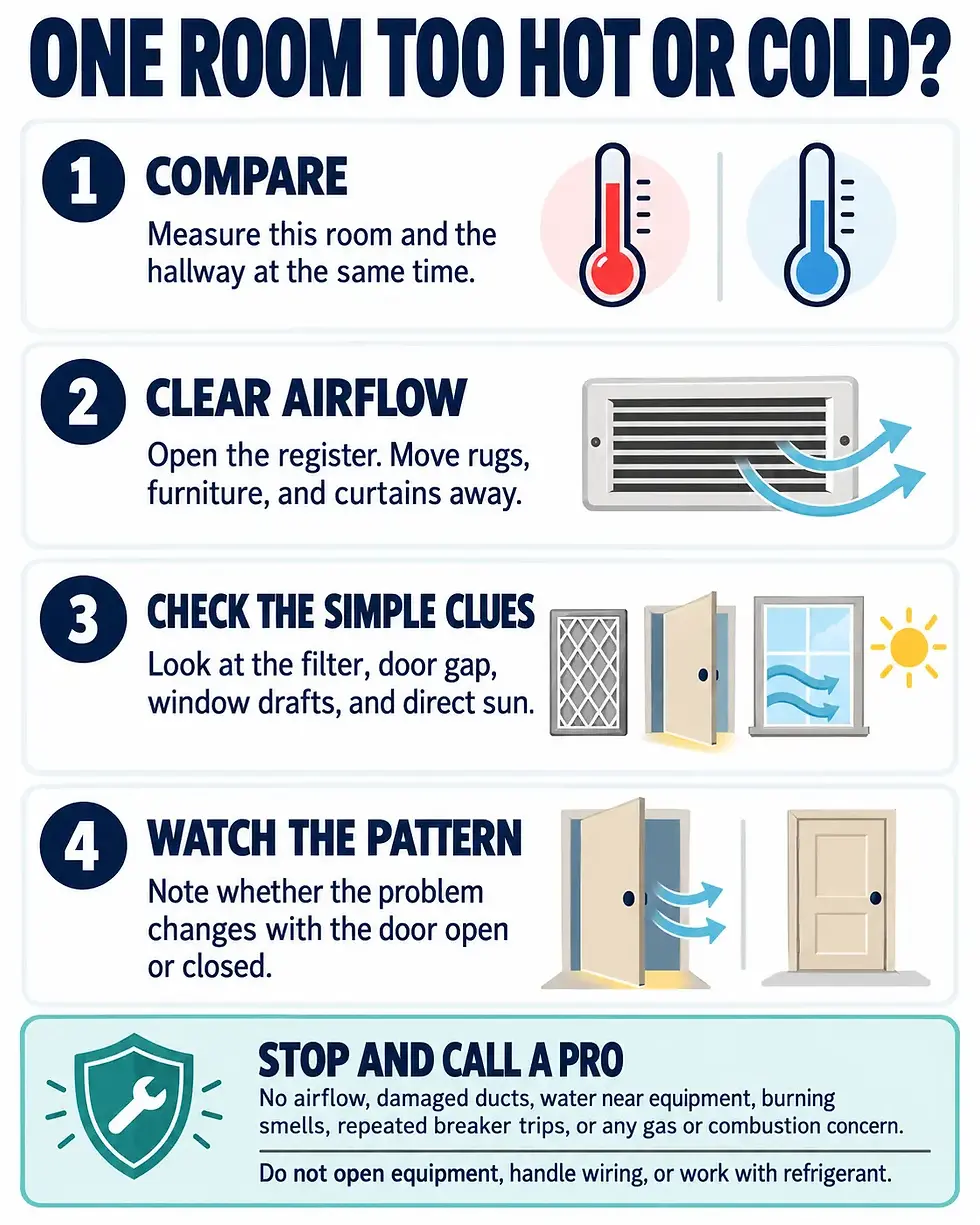
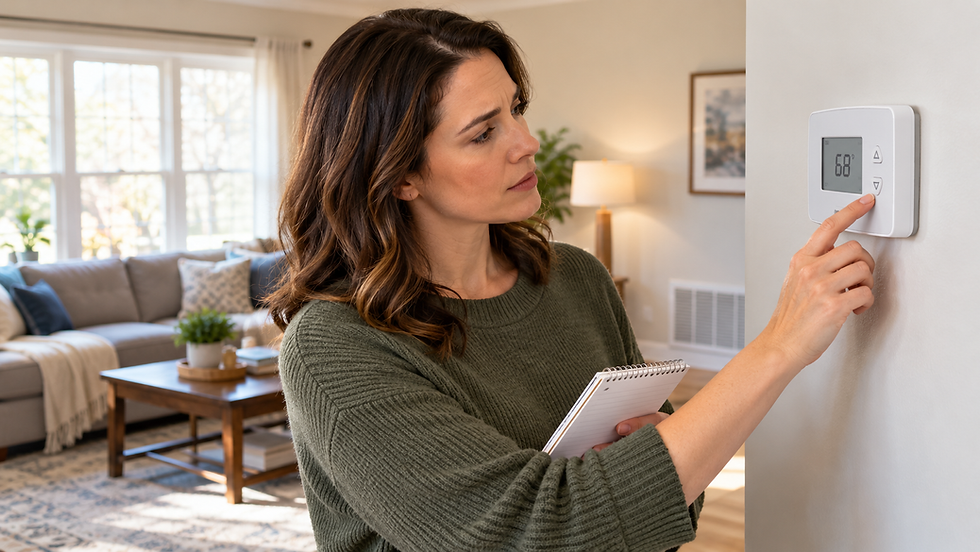
Place a simple thermometer in the problem room and another in the hallway, away from direct sun, lamps, electronics, windows, and supply air. Compare them while the system is actively heating or cooling. Repeat the check at a second time of day. A single reading is useful, but a repeatable pattern is much more informative.
Worse only in the afternoon can point toward direct solar gain or a hot attic boundary.
Worse only with the door closed can point toward a restricted return-air path.
Worse in several rooms at once can point toward a filter, thermostat, equipment, or broader duct problem.
Worse only during very hot or cold weather can point toward insulation, air leakage, duct capacity, or room load.
1. Check the room's supply and return path
Make sure the supply register is fully open and not covered by furniture, rugs, curtains, or storage. If the room has a return grille, keep that clear too. Do not push tools into a register, remove fixed grilles, or close several other registers in an attempt to force air into one room; that can change system pressure without correcting the cause.
With the system running, compare the airflow you can feel at the problem room's register with a similar nearby room. You are looking for a clear difference, not trying to measure professional airflow. If the problem room has almost no airflow, stop at observation and arrange service rather than opening ductwork or equipment.
2. Check the filter and system-wide clues
A dirty or incorrectly installed filter can reduce airflow throughout a forced-air system. Follow the equipment manufacturer's instructions for checking or replacing the filter, including any shutdown step in the manual. Do not reach past the normal filter slot or remove service panels.
If several rooms are uncomfortable or the system cannot reach its set temperature, use the checks in Thermostat Not Reaching the Set Temperature? to separate a room-level issue from a wider heating or cooling problem.
If the equipment runs almost continuously, compare the room pattern with AC Won't Stop Running? before assuming that the problem is only the bedroom or office.
3. Repeat the comparison with the door open
A central HVAC system has to move air into a room and provide a path for air to return to the equipment. If the temperature or airflow feels better with the door open than closed, record that result. It can be a useful clue that the return path is restricted or the room is becoming pressure-imbalanced.
Do not cut the door, add a transfer grille, or modify return ducts based on this test alone. Those changes affect airflow, sound, fire separation, and sometimes combustion safety. Give the open-door and closed-door result to a qualified contractor or home-energy professional.
4. Separate sunlight and air leakage from an airflow problem
A room can receive normal HVAC airflow and still drift warmer or colder because it gains or loses heat faster than the rest of the house. Note direct afternoon sun, large windows, exterior walls, a ceiling below an attic, a floor above a garage or crawlspace, and obvious drafts around windows or exterior doors.
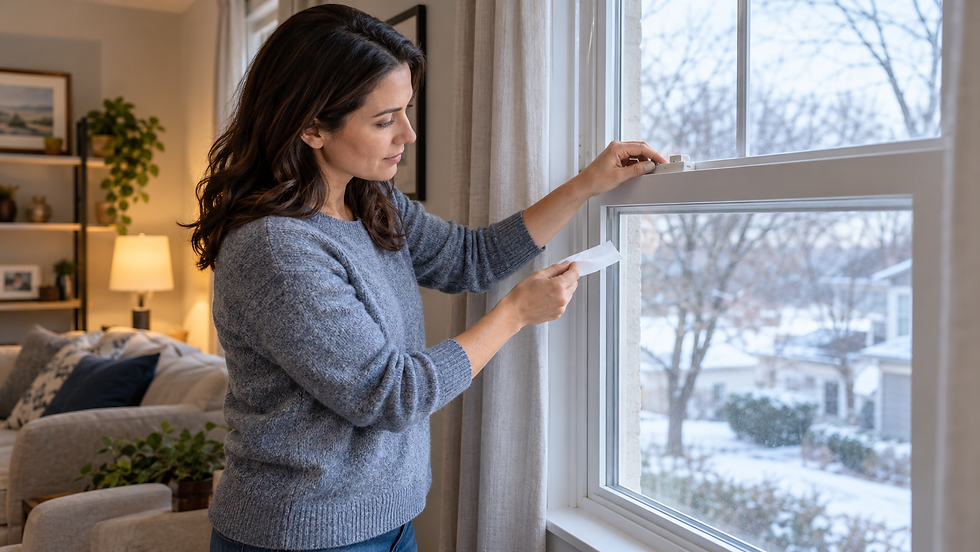
If moving air around a closed window is the strongest clue, follow Draft Coming Through a Closed Window? for a safe inspection of locks, weatherstripping, and visible gaps.
Close blinds or curtains for one comparison period, then record whether the temperature gap changes.
Look for visible gaps, loose weatherstripping, or daylight around an exterior opening without removing trim.
Compare the surface feel of exterior walls, the ceiling, and the floor with nearby rooms; a large difference is a clue for a professional energy assessment.
Do not seal around combustion vents, flues, chimneys, or unknown openings. Air sealing can change combustion and indoor-air conditions.
5. Look for duct clues without entering unsafe spaces
ENERGY STAR identifies difficult-to-heat or difficult-to-cool rooms as a common sign of poorly performing ducts. From a normal living area, look for a loose register boot, a gap where the register meets the floor or wall, unusual dust streaks, or a flexible duct that is plainly visible and kinked. Do not enter an unsafe attic or crawlspace, disturb insulation, or attempt hidden duct repairs.
A contractor can measure room airflow and pressure, check supply and return balance, inspect concealed ducts for leaks or disconnections, and determine whether the room load exceeds what the duct can deliver. A home-energy professional can also evaluate air leakage and insulation where the room borders an attic, garage, crawlspace, or exterior wall.
What the pattern usually suggests
Low airflow at one register: a closed or blocked register, loose boot, crushed or disconnected branch duct, or balancing issue may be involved.
Better comfort with the door open: the room may need a better return-air path or pressure balancing.
Normal airflow but strong afternoon overheating: solar gain, attic heat, window performance, or insulation may be more important than the thermostat.
Normal airflow but winter cold near exterior surfaces: drafts, missing insulation, or an exterior-envelope issue may be contributing.
Several rooms affected: check the filter and thermostat clues, then have the whole system and duct network evaluated.
When to call a professional
Schedule qualified HVAC or home-performance service if the temperature difference is repeatable after registers and furnishings are cleared, one room has little or no airflow, the door-open test changes the result substantially, visible duct damage is outside safe reach, or the room borders an attic or crawlspace that needs testing. Call promptly for burning odors, gas or combustion concerns, water near equipment, repeated breaker trips, arcing sounds, frost or ice on refrigerant lines, or unusual equipment shutdowns.
Tell the technician which room is affected, the hallway and room temperatures, the outdoor conditions, whether the system was heating or cooling, whether the door was open or closed, whether the problem changes by time of day, and how the register airflow compares with a nearby room. Those observations are more useful than guessing at a failed part.
Comments