

Dryer Taking Too Long to Dry? Check Airflow Before You Run Another Cycle

Updated: Aug 31
If your dryer is taking two cycles—or much longer than it used to—the most likely problem is restricted airflow, especially when the clothes come out warm but still damp. Other common causes are an overloaded or mixed load, a washer that left the clothes unusually wet, or a cycle that does not match the fabric. Heat-pump dryers are a special case: they normally use lower-temperature drying and can take longer than conventional vented dryers.
First safe check: clean the lint screen, then—with the dryer stopped—look behind the machine for an obviously crushed or sharply kinked exhaust duct. On a vented dryer, also check that the outside vent hood is not blocked and opens while the dryer runs. If the dryer is hot but clothes stay damp and outside airflow is weak, stop repeated cycles and arrange a full vent inspection/cleaning rather than treating it as a heating problem.
What to do next: try one normal-size load of similar fabrics that came out of the washer well spun. If drying returns to normal after restoring airflow or reducing the load, keep monitoring it. If airflow is good but the dryer has little or no heat, shows an error, shuts off, repeatedly trips a breaker, or still needs multiple cycles, schedule appliance service. Do not open the cabinet or work on internal wiring, gas parts, heating components, or safety devices.
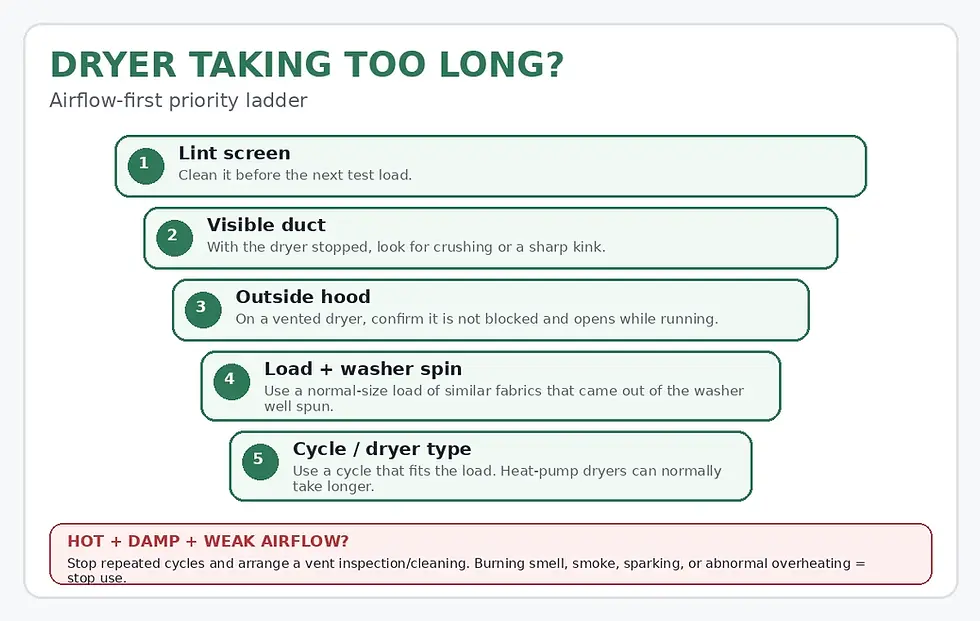
1. Start with airflow—the most common high-value check
Whirlpool’s official dryer guidance says long dry times commonly come from poor ventilation or restricted airflow. A full lint screen, crushed or kinked duct, excessive vent length, lint buildup, debris, or an obstructed outside hood can keep hot, moist air from escaping. That can leave the drum and clothes warm while the load remains damp.
Safe homeowner checks are limited to accessible, external items: clean the lint screen; inspect the visible duct behind the dryer for crushing or sharp bends with the dryer stopped; and verify the exterior hood is not blocked by lint, debris, nests, plants, or snow. If the full vent run is not safely accessible, use a qualified vent-cleaning service rather than disassembling the dryer.
2. If the clothes are hot but still damp
Hot-but-damp laundry strongly points you toward moisture removal and airflow before you assume the heater has failed. Whirlpool specifically notes that if a dryer is heating but still has long dry times, restricted venting is a likely cause. Repeatedly running extra cycles can add heat without solving the moisture-exhaust problem.
3. Check the load and the washer spin
An overloaded dryer or a load that mixes heavy towels with light fabrics can extend drying time because air cannot circulate evenly and different items dry at different rates. Also check how wet the laundry is before it enters the dryer. If the washer did not spin water out effectively, the dryer must remove far more moisture. Test with a normal-size load of similar fabrics after a full washer spin.
4. Make sure the cycle fits the load
Automatic sensor cycles and timed cycles behave differently. A cycle that is too gentle for a heavy load can take longer, while a very small load may not contact moisture sensors consistently on some designs. Follow the cycle guidance in your model’s manual rather than increasing heat or bypassing sensors.
5. Heat-pump and ventless dryers need a different expectation
Do not apply vented-dryer rules blindly to a heat-pump dryer. LG explains that heat-pump dryers warm the air differently and may feel slower than gas or conventional electric dryers; colder surroundings can also increase drying time on some models. For these machines, keep the model-specific filters, heat-exchanger area, drain or water tank, and ambient-temperature requirements in the owner’s manual in mind. Do not open sealed refrigerant components.
When slow drying is a safety issue
Stop using the dryer if you notice a burning smell, smoke, scorching, sparking, repeated breaker trips, abnormal overheating, or signs that exhaust air is not escaping. CPSC and the U.S. Fire Administration warn that lint and restricted venting can contribute to dryer fires; failure to clean is a leading factor in home dryer fires. If you smell gas, leave the area and contact your gas utility or emergency service from a safe location. Do not search for the leak or operate switches.
When to call for service
Call a qualified appliance technician when the vent path is confirmed clear but the dryer still takes multiple cycles, there is little or no heat, the machine stops unexpectedly, an error returns, or performance suddenly changed without an obvious load or airflow cause. Internal thermostats, thermal fuses, heaters, gas valves, motors, sensors, control boards, and wiring are professional-service territory.
Related Home Fixes HQ guides
Dryer not heating but still running: https://www.homefixeshq.com/post/dryer-not-heating
Dryer getting too hot: https://www.homefixeshq.com/post/dryer-gets-too-hot
Related dryer guides
Related dryer guides: Dryer Not Heating but Still Running · Dryer Getting Too Hot? What to Check Before You Run It Again
Official sources
Whirlpool — Dryer is not Drying or Experiencing Long Dry Times: https://producthelp.whirlpool.com/Laundry/Dryers/Product_Info/Dryer_Product_Assistance/Dryer_is_not_Drying_or_Experiencing_Long_Dry_Times
Whirlpool — How to Check Venting: https://producthelp.whirlpool.com/Laundry/Dryers/Product_Info/Dryer_Product_Assistance/How_to_Check_Venting
LG — Heat Pump Dryer Drying Time Is Long: https://www.lg.com/us/support/help-library/lg-dryer-drying-time-electric-heat-pump-the-drying-time-is-long-drying-takes-a-long-time--20154713253684
U.S. Consumer Product Safety Commission — Overheated Clothes Dryers Can Cause Fires: https://www.cpsc.gov/Safety-Education/Safety-Guides/Home-Fire-Electronics-and-Electrical/Overheated-Clothes-Dryers-Can-Cause-Fires
U.S. Fire Administration — Appliance and Electrical Fire Safety: https://www.usfa.fema.gov/prevention/home-fires/prevent-fires/appliance-and-electrical/


Comments