
AC Running but Not Cooling? Separate Airflow, Ice, and Outdoor-Unit Clues

Updated: Sep 10
Quick answer: If your central AC is running but the house is not getting cooler, the most likely homeowner-checkable causes are an incorrect thermostat or fan setting, a dirty air filter that is restricting airflow, blocked return or supply airflow, or debris restricting airflow around the outdoor condenser. More serious causes include a frozen evaporator coil, refrigerant loss, an outdoor-unit electrical or mechanical failure, or a system that cannot meet the home’s cooling load. Carrier and Trane both put thermostat, filter, airflow, and outdoor-unit checks near the top of their official troubleshooting guidance.
First safe check: Set the thermostat to COOL, set the fan to AUTO, and set the target temperature below the current room temperature. Then inspect only the filter location your system manual identifies as homeowner-accessible. If the filter is visibly dirty, replace or clean it according to the equipment instructions. Do not open equipment panels to reach a filter or component that is not intended for routine homeowner access.
What to do next: If those settings and the accessible filter are okay, check that return grilles and supply vents are not blocked, look at the outdoor unit from the outside for leaves or tall grass around it, and look for visible ice on accessible refrigerant lines or the indoor unit area. If you see ice, smell burning, hear abnormal electrical sounds, see sparking, or the system repeatedly trips a breaker, stop troubleshooting and arrange professional service. Do not keep resetting a breaker or open electrical or refrigerant compartments.
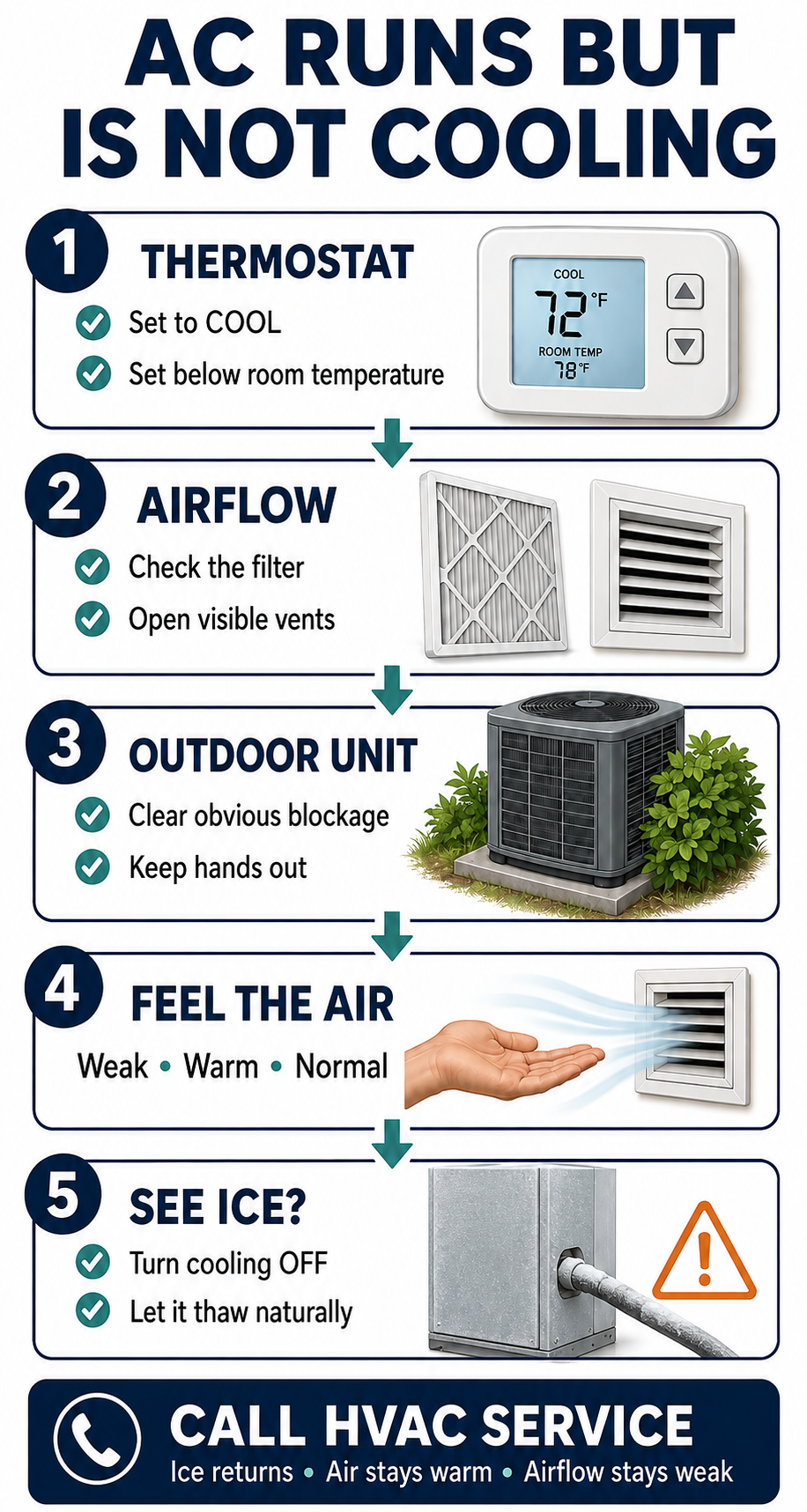
5 Safe Checks to Make Before Calling for Service
1. Confirm the thermostat is actually calling for cooling
Make sure the mode is COOL, the target temperature is below the room temperature, and the fan is set to AUTO rather than ON. A fan set to ON can make the indoor blower run between cooling cycles, which can feel like the system is “running” even when the refrigeration side is not actively cooling. Trane specifically recommends checking COOL mode, a lower setpoint, and AUTO fan operation when an AC is not blowing cold air.
2. Check the accessible air filter and basic indoor airflow
A clogged filter can reduce airflow enough to weaken cooling and contribute to coil icing. Inspect the filter only if it is in a normal homeowner-service location such as a return grille or clearly accessible filter slot. Replace or clean it using the size, direction, and method specified by your system or filter instructions. Also make sure furniture, rugs, boxes, or closed registers are not blocking normal return and supply airflow.
3. Look for obvious blockage around the outdoor unit
From outside the cabinet, remove loose leaves, sticks, or tall grass that are crowding the unit and preventing free airflow around it. Do not remove the service panel, reach through the fan guard, touch electrical parts, or attempt internal coil or electrical repairs. Trane advises clearing surrounding grass, sticks, and leaves; Carrier also lists a blocked outdoor condenser among common causes of poor cooling.
4. Notice whether airflow is weak, normal, or warm
This observation helps decide what comes next. Weak airflow after a dirty filter is corrected can point to an airflow or blower problem that needs service. Normal-strength airflow that stays warm suggests the system is moving air but is not removing enough heat. If the indoor blower runs but the outdoor unit is silent during an active cooling call, treat that as a service clue—not an invitation to open the disconnect, test a capacitor, or inspect internal wiring.
5. Look for visible ice and stop cooling if you find it
Visible ice on accessible refrigerant lines or around the indoor coil area is a reason to turn cooling OFF at the thermostat. A dirty filter can contribute to freezing, but low refrigerant or other faults can also be involved. Trane says a visibly frozen evaporator coil should be turned off and professionally serviced. For a deeper symptom-specific path, see our AC Freezing Up: What the Ice Means and What to Check First.
Use the Symptom to Choose the Next Step
The filter was dirty and airflow improves after replacement: keep the system on normal cooling settings and watch whether indoor temperature begins to fall. If cooling still does not recover, schedule HVAC service.
Airflow is weak even with a clean filter and open vents: stop at external checks. A blower, indoor coil, duct, or other airflow problem may need professional diagnosis.
Airflow feels normal but stays warm: after thermostat and outdoor-obstruction checks, professional diagnosis is appropriate because refrigerant, compressor, controls, or other mechanical causes are possible.
The outdoor unit is not operating while the indoor blower runs: do not remove panels, open the disconnect, test capacitors/contactors, or probe wiring. Schedule service.
You see ice: turn cooling OFF and arrange service if it returns or the cause is not clearly resolved by a routine accessible-filter correction.
The system cools somewhat but never reaches the setpoint during extreme heat: equipment sizing, building heat gain, duct losses, or system condition may be involved. A qualified HVAC professional can evaluate capacity rather than guessing from one symptom.
What Homeowners Should Not DIY
Keep troubleshooting on the outside of the system. Refrigerant circuits, capacitors, contactors, compressor terminals, internal wiring, control boards, disconnects, and sealed-system components require training and appropriate equipment. Do not bypass safety switches, add refrigerant, attach gauges, probe live voltage, or remove panels to “see what failed.”
EPA Section 608 rules require certification for technicians who perform servicing work that can release regulated refrigerants, including attaching gauges and adding or removing refrigerant. EPA also notes that refrigerants can present toxicity, flammability, asphyxiation, and physical hazards. That is why a suspected refrigerant problem belongs in the professional-only branch of this troubleshooting path.
Stop Using the AC and Get Help If You Notice These Signs
Burning or strong electrical odor, smoke, visible sparking, or abnormal heat.
A breaker that trips repeatedly. Do not keep resetting it.
Loud grinding, metal-on-metal sounds, or other severe mechanical noise.
Visible ice that returns after the system thaws or after an accessible dirty filter is corrected.
Water reaching electrical equipment or an electrical burning smell near the indoor or outdoor unit.
The outdoor unit remains off, hums abnormally, or the home stays warm after the safe checks above.
If there is active smoke or fire, keep clear of the equipment and use emergency services. Otherwise, switch cooling off at the thermostat if it is safe to do so and arrange qualified HVAC or electrical service as appropriate.
A Practical Resolution Path
Thermostat: COOL, fan AUTO, target below room temperature.
Accessible filter: clean or replace if dirty, following the equipment instructions.
Airflow: make sure return grilles and supply vents are open and unobstructed.
Outdoor unit: clear only loose surrounding vegetation or debris without opening the cabinet.
Ice or unsafe symptoms: turn cooling off and stop homeowner troubleshooting.
Still not cooling: book HVAC service and tell the technician whether airflow was weak or normal, whether the outdoor unit was running, whether you saw ice, and what you already checked.
That symptom history is more useful than guessing at a failed part. It helps the technician separate an airflow problem from a refrigeration, electrical, mechanical, or capacity problem while keeping the homeowner on the safe side of the system.


Comments