
AC Won’t Turn On? Separate Thermostat, Power, and Safety-Shutoff Clues

Updated: Sep 10
If your central AC is completely dead, the most likely starting points are the thermostat, a power interruption, a clogged filter, or a condensate safety shutdown. Start with the thermostat: make sure it is set to COOL, the fan is on AUTO, and the set temperature is below the room temperature. If the thermostat uses batteries and the screen is blank, replace the batteries.
Next, check only what you can see safely: the HVAC filter, any obvious water around the indoor unit or drain pan, the normal indoor shutoff switch position, and whether an AC breaker appears tripped. Do not open equipment panels, touch wiring, handle capacitors, connect refrigerant gauges, or bypass a safety switch. If a breaker is tripped, Trane’s current homeowner guidance says to contact an HVAC professional rather than flipping it back on, because the trip may signal a serious system problem.
What to do next: correct a simple thermostat setting or battery problem, replace a dirty filter if it is normally homeowner-serviceable, and keep the system off if you see a tripped breaker, water threatening electrical parts, burning odor, buzzing, or ice. If the AC still will not start after the safe checks below, schedule HVAC service.

1. Check the thermostat first
A thermostat that is off, set to HEAT, set above the room temperature, or running on dead batteries may never send a cooling call. Trane specifically recommends checking for a blank screen, replacing batteries when applicable, selecting COOL, setting the fan to AUTO, and placing the cooling setpoint below the current indoor temperature.
Screen blank and the thermostat uses replaceable batteries: install fresh batteries according to the thermostat instructions.
Screen on: confirm the mode is COOL, fan is AUTO, and the cooling setpoint is below the displayed room temperature.
Screen still blank on a hard-wired thermostat, or settings look correct but nothing responds: stop here and move to the safe visual checks below. Do not remove wiring or troubleshoot low-voltage circuits yourself.
2. Look at the air filter
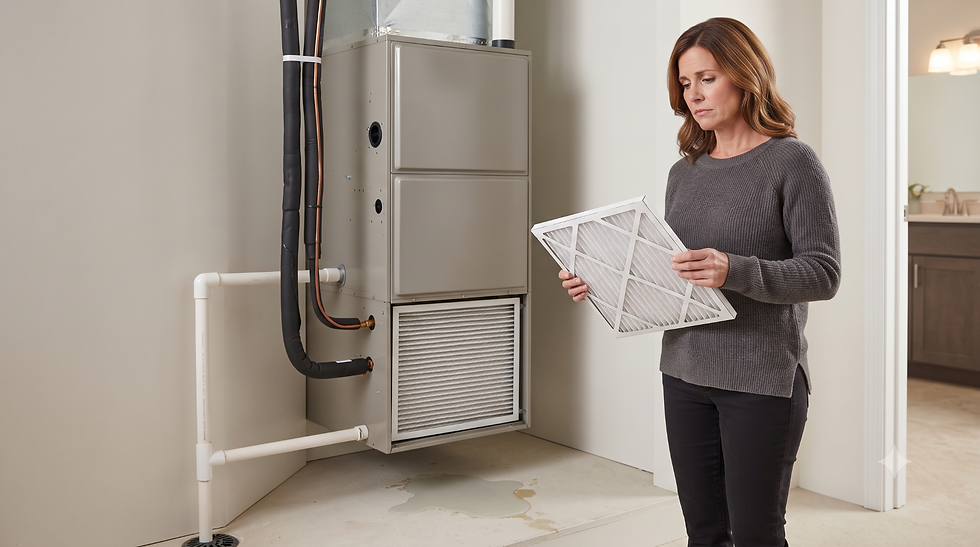
A heavily clogged filter restricts airflow. Trane notes that poor airflow can contribute to a frozen evaporator coil and a shutdown. If your filter is in a normal homeowner-accessible slot or return grille, inspect it and replace it if it is visibly dirty, using the correct size and type for your system.
Do not open the evaporator-coil cabinet to inspect internal parts. If you already see ice on accessible insulated refrigerant tubing or around the indoor coil area, leave cooling off and call for service rather than trying to chip or melt the ice.
3. Check for condensate water or a safety shutdown
Central air conditioners remove moisture from indoor air, and that condensate normally drains away. Trane explains that some systems use a condensate safety switch that shuts the indoor unit down when the drain pan water rises. That means an AC that appears completely dead can sometimes be reacting to a drainage problem rather than an electrical failure.
Safe homeowner check: look around the indoor unit and drain pan for standing water, overflow, rust, or a fresh puddle. If water is present near electrical components, keep clear and leave the system off. Do not bypass or hold a float/safety switch down to force the AC to run. A blocked drain or recurring water backup should be corrected by an HVAC professional.
4. Check power status without doing electrical repair
Trane lists an indoor HVAC shutoff switch and a tripped indoor or outdoor breaker as possible reasons an AC will not start. A nearby indoor service switch can look like a light switch. You can verify that an obvious, normally accessible HVAC switch has not accidentally been turned off.
At the electrical panel, limit your check to observing the breaker position. For this troubleshooting path, do not repeatedly reset a tripped AC breaker. Trane’s dedicated “AC Not Turning On” guidance tells homeowners to contact an HVAC professional if the breaker is tripped instead of flipping it, because an underlying HVAC fault may have caused the trip.
5. Use the symptom to decide who needs to fix it
If the thermostat and filter look normal, there is no obvious condensate overflow, and the unit still will not start, the remaining causes increasingly move into professional-service territory. Carrier lists failed capacitors or contactors, refrigerant leaks, wiring faults, and motor failures among possible no-start causes. Those are not homeowner DIY repairs.
Burning smell, smoke, sparking, unusual heat, or damaged wiring: stop using the system and keep clear. Arrange qualified service; use emergency services if there is an active fire or immediate danger.
Buzzing from the indoor or outdoor equipment while it will not start: turn the system off and call HVAC service.
Visible ice: leave cooling off and schedule service. Do not chip ice or apply a torch, heat gun, or other heat source.
Breaker is tripped: leave it alone and call a professional under the conservative Trane guidance used for this article.
Possible refrigerant problem: do not attach gauges, open the refrigerant circuit, or add refrigerant yourself.
Why refrigerant work is professional-only
EPA Section 608 rules require certification for technicians whose maintenance, service, or repair could release refrigerant. EPA specifically includes actions such as attaching or detaching hoses and gauges, adding or removing refrigerant, or otherwise opening the refrigerant circuit. If a no-start condition points to low refrigerant, a leak, a pressure-related safety shutdown, or sealed-system work, that is a service call—not a homeowner test.
A quick decision path
Thermostat setting or dead batteries were the problem: correct them and see whether normal cooling starts.
Filter is very dirty but everything else looks normal: replace the accessible filter, then test the system normally.
There is standing condensate water or evidence of drain backup: leave the system off and arrange service rather than bypassing the safety device.
A breaker is tripped, or there is burning odor, buzzing, ice, or abnormal heat: stop troubleshooting and call a qualified HVAC professional.
All safe checks look normal but the AC is still dead: schedule service for control, capacitor/contactor, motor, wiring, refrigerant, or other internal diagnosis.
Make sure you have the right AC problem
If the system actually runs but the house is not getting cool, use our separate guide: AC Running but Not Cooling.
If the system is icing up, use this guide instead: AC Freezing Up. These are different troubleshooting paths from an AC that will not turn on at all.
Official sources used
Trane — AC Not Turning On
Trane — AC Condensate Drain Line Clogged
U.S. EPA — Section 608 Technician Certification


Comments