

Furnace Keeps Turning On and Off? Check These Safe Clues First

A furnace that starts, runs briefly, shuts off, and then starts again before the home reaches the thermostat setting may be short cycling. The safest first checks are outside the equipment: confirm the thermostat mode, distinguish burner heat from the blower fan, check only the filter location identified for homeowners in the manual, and make sure supply and return vents are open. Keep every furnace panel closed. If the pattern continues after those checks, turn the system off at the normal thermostat control and arrange qualified HVAC service.
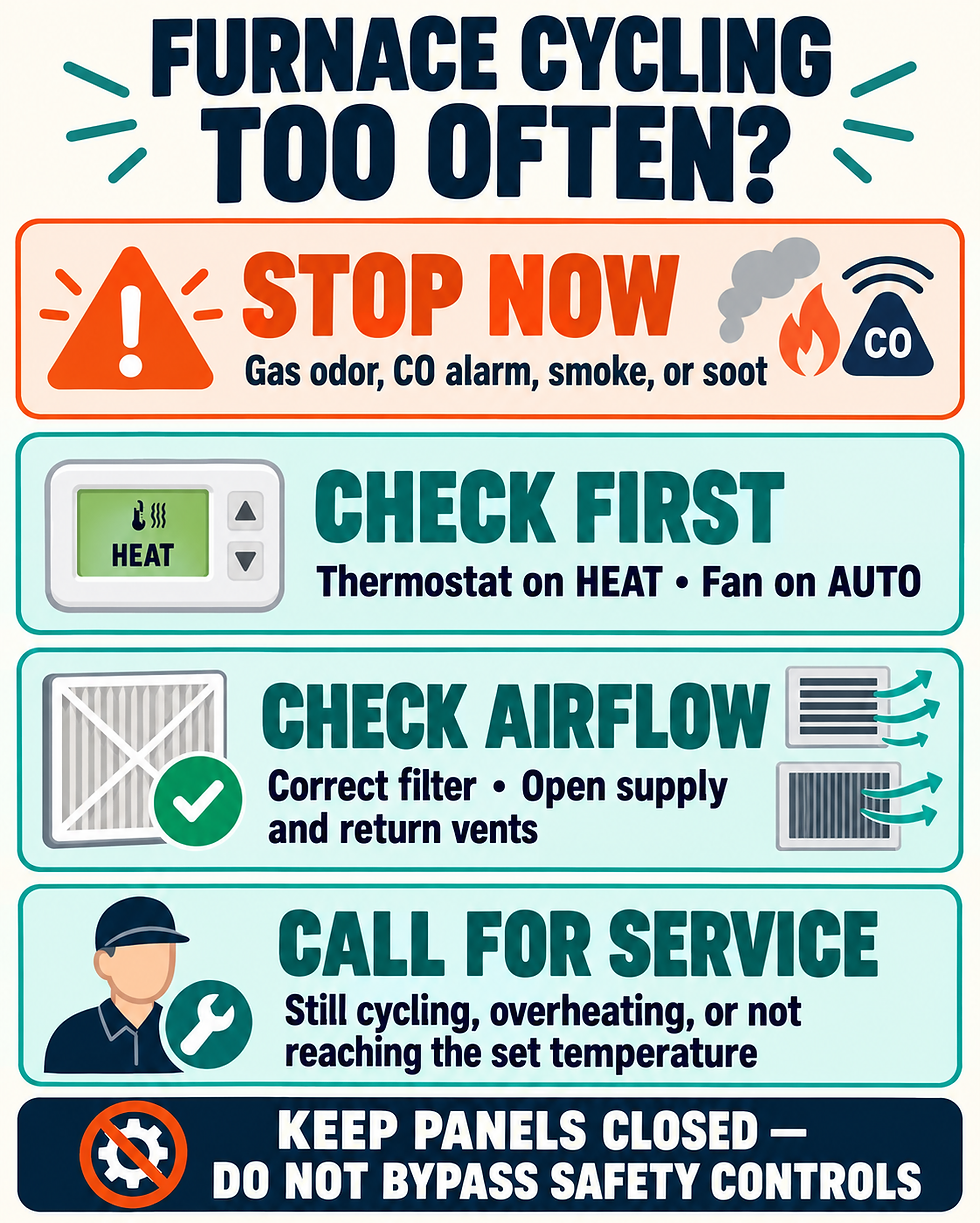
Leave the home and get help now if you notice these signs
A natural-gas or rotten-egg odor. Leave immediately without operating switches, flames, phones, or appliances inside; call 911 and the gas utility from outdoors.
A carbon monoxide alarm, or people in the home developing headache, dizziness, nausea, confusion, or unusual weakness. Move to fresh air and call emergency services.
Smoke, visible soot, scorching, melting, or a strong electrical or overheating odor near the furnace or vents.
Visible flame outside the normal enclosed combustion area, repeated booming or delayed ignition sounds, or any sign that combustion is not contained.
A furnace cabinet, vent connector, flue, safety switch, or access panel that is loose, damaged, missing, or has been altered.
Do not restart the furnace to see whether a warning happens again. Do not open the cabinet, inspect burners, clean a flame sensor, adjust a gas valve, touch wiring, defeat a door switch, bypass a limit control, or block a vent. Fuel-burning equipment, combustion, flues, electrical controls, and heat exchangers require qualified service.
Quick check: is it really short cycling?
Heating cycles vary with outdoor temperature, equipment type, staging, home heat loss, and thermostat logic, so a single universal minute limit is not reliable. The useful clue is the pattern: the thermostat is still asking for heat, the room has not reached the set temperature, yet the heat stops and starts repeatedly.
The burners or heat stop, but the blower continues briefly: that may be a normal cool-down period—or a response to overheating. Do not diagnose the internal cause yourself.
The thermostat reaches the set temperature and the system rests: that can be a normal completed cycle.
Only the fan runs continuously while heat comes and goes: check whether the thermostat fan setting is ON instead of AUTO.
The furnace stops before the set temperature, restarts a short time later, and repeats: treat that as a service issue if the safe checks below do not correct an obvious airflow or setting problem.
1. Watch one complete call for heat
Use the thermostat normally. Set it to HEAT and choose a temperature a few degrees above the current room reading. Put the fan setting on AUTO unless the manufacturer’s instructions say otherwise. Then observe from the living space, not from inside the furnace cabinet.
Note the thermostat reading, the time the heat begins, whether warm air reaches the rooms, when the heat stops, and whether the set temperature was reached. One written observation is more useful to a technician than repeatedly forcing new cycles. Do not rapidly raise and lower the setpoint, power-cycle the furnace, or reset a breaker or safety control.
2. Check the thermostat context
Look for a simple explanation the thermostat can reveal without removal: HEAT versus OFF, AUTO versus ON for the fan, a scheduled setback, a low-battery message, or an error shown on the normal display. Follow only the thermostat maker’s owner instructions for batteries or schedule settings.
Direct sun, a nearby supply register, an exterior-door draft, a lamp, or another heat source can make a thermostat sense a temperature that does not represent the rest of the home. Record that clue, but do not move the thermostat or open its wiring base. Wiring, calibration, equipment configuration, and relocation belong to a qualified technician.
3. Check only the owner-accessible filter
Restricted airflow is a common short-cycling clue. ENERGY STAR advises checking the filter monthly during heavy heating and cooling use, while furnace manufacturers emphasize using the correct type and size. If the owner’s manual identifies a filter at a return grille or in an exterior slot that is meant for routine homeowner access, compare it with the manual and its airflow-direction marking.
Replace a visibly dirty disposable filter, or clean a reusable filter, only exactly as the manufacturer directs. Use the specified dimensions and compatible rating. A filter that is too restrictive, incorrectly oriented, doubled up, or not fully seated can reduce airflow. Never remove a furnace access panel to reach a filter, run the system without the filter, or improvise a substitute.
4. Open and uncover supply and return vents
Walk through the home and confirm that supply registers are open and not covered by rugs, furniture, curtains, or boxes. Return grilles also need clear space for air to get back to the system. Do not close many registers in unused rooms as an energy-saving shortcut; reducing airflow can work against the furnace and comfort.
Do not place objects into ducts, remove grilles that conceal wiring or equipment, or attempt to clean internal ductwork during this check. If several rooms have weak airflow while the filter and visible grilles are clear, record which rooms are affected and call for service.
What the pattern can tell the technician
It started after a filter change
The new filter may be the wrong dimensions, installed in the wrong direction, not seated correctly, or more restrictive than the system permits. Compare the exact filter specification with the equipment manual. If the correct filter is installed and cycling continues, stop the test and arrange service.
It happens only during very cold weather
Longer or more frequent operation can be normal during severe weather, but repeated shutdowns before the thermostat is satisfied still deserve attention. Write down outdoor conditions and the indoor temperature. Do not assume the system is safe merely because the pattern is weather-dependent.
It began after a new furnace or major insulation work
An oversized furnace can warm the thermostat area quickly and stop before heat is evenly distributed. Building-envelope changes can also alter the home’s heating load. Equipment sizing requires a professional load calculation; it cannot be confirmed by timing one cycle or comparing only the old furnace’s nameplate.
The thermostat goes blank or reboots
A blank or restarting thermostat can point to a power, control, wiring, drainage, or equipment protection issue. Do not open the thermostat base, furnace panel, condensate controls, or electrical compartment. Use another safe heat source only according to its instructions and arrange HVAC service.
Warm air becomes cool before the room reaches temperature
The blower may be completing a normal cool-down, or the heating stage may have stopped early. If the main symptom is ongoing cold air rather than repeated complete cycles, use the separate guide Furnace Blowing Cold Air? Check These 5 Safe Things First. It keeps the diagnosis outside the combustion and electrical compartments.
Why persistent short cycling needs professional diagnosis
After thermostat, filter, and visible airflow checks, the remaining causes are not safe do-it-yourself targets. Manufacturer guidance lists possibilities such as a limit switch response, flame-sensing or ignition trouble, venting restrictions, control faults, blower problems, heat-exchanger damage, and incorrect equipment sizing. These systems contain safeguards intended to stop unsafe operation.
A technician can measure airflow and temperature rise, verify thermostat signals, inspect combustion and venting, test safety controls, and compare the installation with the furnace model’s requirements. Do not bypass a control because it appears to be causing the shutdown—the control may be responding to the actual hazard.
When to stop testing and schedule service
The furnace still stops before reaching the set temperature after the correct filter and visible vents are checked.
Cycling returns after a temporary improvement or becomes more frequent.
The cabinet or nearby air feels unusually hot, a breaker trips, or the thermostat blanks or restarts.
The problem began after installation, duct changes, insulation work, thermostat replacement, or another system modification.
The furnace has not received its recommended annual professional inspection.
You cannot identify the correct filter or reach it without opening an equipment panel.
If the furnace will not start at all, follow the separate Furnace Won’t Turn On? Check These 4 Safe Things Before You Call for Service. For more observation-first heating and cooling guides, browse the HVAC troubleshooting library.
What to tell the HVAC technician
The thermostat setpoint and room temperature when the cycle began.
Whether the heat stopped before the setpoint was reached.
Approximate run and off times from one or two observed cycles.
Whether the blower continued after the heat stopped.
Filter model, dimensions, and the date it was last changed.
Which supply registers or rooms had weak airflow.
Any display message, unusual sound, odor, soot, alarm, or recent system change.
Do not remove panels to collect more information. Photos of the thermostat display, the exterior furnace label, and the installed filter package can help only when they can be taken without touching or opening equipment.
Frequently asked questions
Can a dirty filter make a furnace turn on and off?
Yes. Carrier and Trane both identify restricted airflow from a dirty filter as a common short-cycling cause. Reduced airflow can contribute to overheating and a protective shutdown. Use only the correct owner-accessible filter specified for the system.
Should I keep resetting the furnace?
No. Repeated resets can hide a recurring protection event and add more start attempts without correcting the cause. Use the normal thermostat control once to stop operation, then arrange service if cycling persists or any warning sign appears.
Is short cycling always dangerous?
Not every short cycle means an immediate emergency, and normal cycle length varies. But repeated early shutdowns can indicate restricted airflow, overheating, a control problem, combustion trouble, or incorrect sizing. Gas odor, a CO alarm, smoke, soot, or illness symptoms require immediate evacuation and emergency help.
How often should a fuel-burning furnace be inspected?
CPSC urges an annual professional inspection of fuel-burning home heating systems, including the furnace, chimney, flue, and vents. ENERGY STAR also recommends yearly HVAC tune-ups for efficiency and comfort.


Comments