

Clothes Still Soaking Wet After Washing? Check the Spin Clues

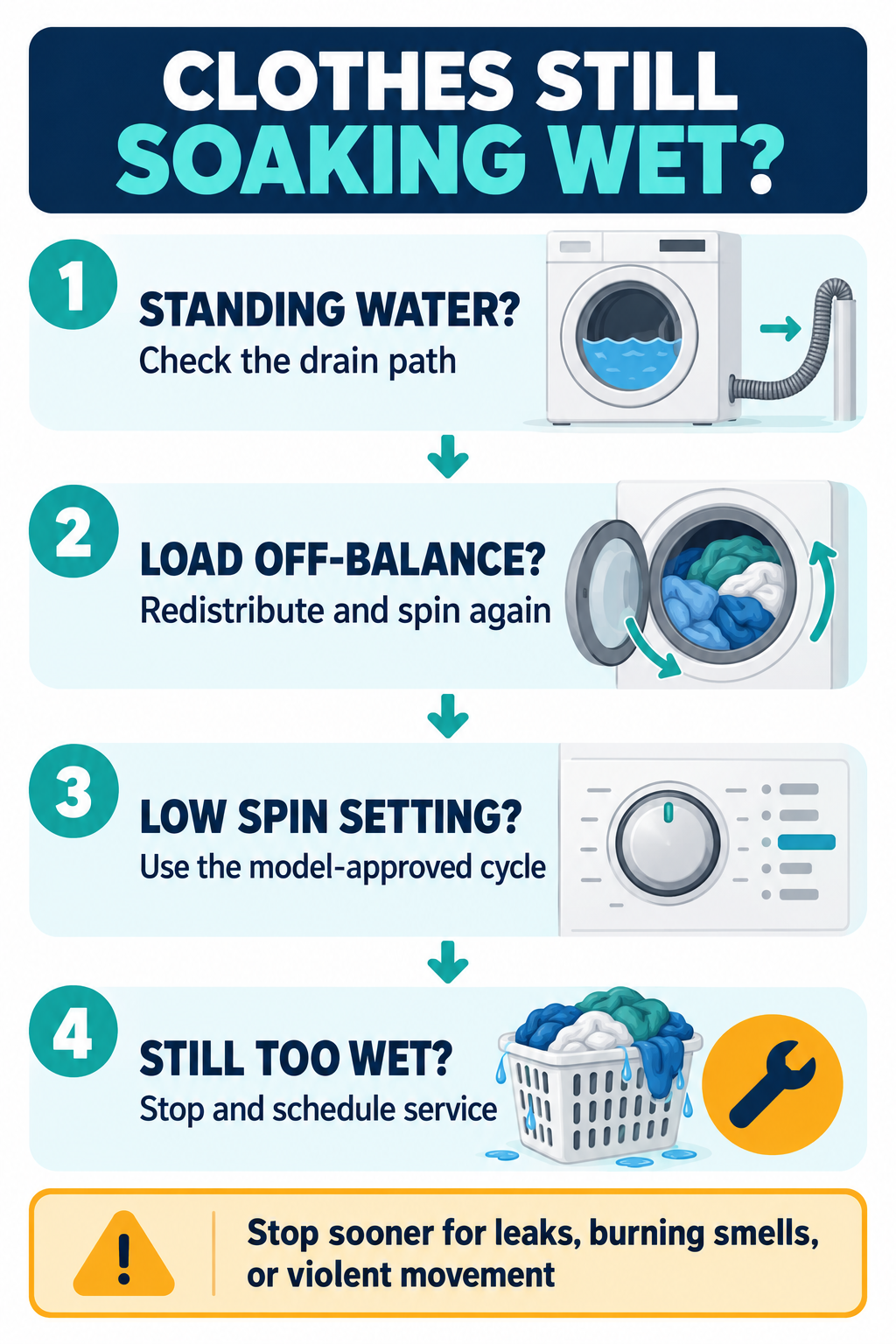
If clothes come out dripping wet, first look inside the washer. Standing water points to a drainage problem. An empty tub with soggy laundry points more often to load imbalance, a low-spin cycle, interrupted power, leveling, or a spin problem. Do not put a dripping load straight into the dryer; remove the extra water first.
Stop before troubleshooting if you see a hazard
Stop the washer and arrange service if you smell burning, see smoke or sparks, find water near the plug, outlet, cord, or controls, hear metal-on-metal grinding, or the machine moves violently. Do not remove panels, bypass the door or lid lock, reach into a moving drum, or open an internal pump or electrical compartment. If the plug is dry and safely reachable, unplug the washer; otherwise leave it alone and call a qualified appliance technician.
First split: standing water or only wet clothes?
Water is still in the tub: treat this as a drainage symptom. Follow the visible drain path and the safe checks in Washing Machine Won’t Drain? Follow the Water Path.
The tub is empty, but the clothes are soaked: focus on load balance, cycle choice, spin speed, leveling, and whether the spin completed. If the washer never reached spin, use Washing Machine Won’t Spin? Drain First, Then Check the Load.
Not sure which symptom you have? Start with the washing-machine symptom guide and route by the stage where the cycle changed.
1. Confirm that the cycle actually finished
Check the display for an error code, paused state, power interruption, or an unfinished cycle. A late pause or outage can keep the washer from reaching full spin speed. Record the exact code before clearing it, then use the model’s manual or official support page. Do not repeatedly restart a machine that leaks, smells hot, or makes a new harsh noise.
2. Redistribute the load
Sheets, blankets, towels, waterproof items, and very small loads can collect on one side. Many washers slow or interrupt the spin when the load is off-balance. With the drum fully stopped and the door or lid unlocked normally, separate tangled items and spread the load more evenly. Do not force a locked door.
Run one model-approved spin or drain-and-spin cycle only if there is no leak, burning smell, violent movement, or unresolved error. If the same balanced load stays soaked again, stop repeating tests and schedule service.
3. Check the cycle and spin setting
Delicate, hand-wash, wool, sportswear, low-spin, and no-spin settings intentionally remove less water. Match the cycle to the fabric and follow the model manual; do not assume the highest spin is safe for every item. If the machine offers a model-approved Spin Only or Drain & Spin option, it can remove extra water after the load has been redistributed.
4. Check the washer’s stance without moving it
From the outside, confirm that the washer is not rocking and that the floor is solid. An unlevel washer can struggle to spin evenly and may become noisy or unstable. Do not pull a stacked or heavy machine away from the wall by yourself. If it needs to be moved or its feet need adjustment and you cannot do that safely, arrange service or installation help.
5. Look at the visible drain hose
If the hose is already visible without moving the washer, check for a sharp kink, crushing, freezing, or a hose pushed unusually far into the standpipe. Installation heights and insertion depth vary by model, so use the owner’s manual instead of copying a generic measurement. Do not disconnect a hose while the tub contains water, and do not snake or dismantle internal drain parts.
What the result usually means
Only one bulky or tangled load was affected: imbalance or the selected cycle is more likely. Change the load arrangement and use the manual-recommended cycle.
Several ordinary loads remain wet, but the tub drains: the washer may not be reaching full spin speed. Stop after one controlled retest and arrange service.
Water remains in the tub: follow the drainage path first. A drain restriction, installation issue, pump fault, or household drain problem may be involved.
The washer shakes hard, walks, grinds, leaks, smells hot, or repeats an error: stop using it. These are not situations for internal DIY inspection.
What not to do
Do not bypass a safety lock, hold a switch closed, remove service panels, touch wiring or capacitors, reach into a moving basket, or disassemble the pump. Do not keep feeding power to a washer that is wet underneath or near electrical connections. Do not transfer dripping clothes directly to the dryer; extra water increases drying time and can create excessive moisture.
When to call for service
Schedule service when ordinary balanced loads stay soaking wet after one correct cycle, the tub repeatedly retains water, spin errors return, the washer cannot stay level, or the machine develops a leak, burning smell, electrical symptom, severe vibration, grinding, or metal contact. Give the technician the model number, exact error code, load type, and whether water remained in the tub.
Frequently asked questions
Can I run another spin cycle?
Yes, once, if the tub drains, the load is redistributed, the model supports that cycle, and there is no leak, burning smell, violent movement, or unresolved error. Repeated failed attempts are a service clue.
Why are towels wetter than shirts?
Heavy absorbent items hold more water and can bunch on one side. A bulky or towel cycle may use a different spin pattern. Follow the care labels and the washer manual rather than combining one heavy item with a few light pieces.
Does wet laundry always mean the washer is broken?
No. A low-spin setting, an interrupted cycle, an off-balance load, or an installation issue can cause the same result. Repeated wet loads under normal conditions make a washer or drainage fault more likely.
Official sources
Model designs and cycle names vary. Use the instructions for your exact model when they differ from this general troubleshooting guide.


Comments